
MA Filmmaking
Develop your voice as a filmmaker, balancing industry focus with experimental production techniques.
Fact file
Typical offer
Course length
Course overview

Course information
Features and benefits

Industry links
Work on live briefs with external partners and communities linked to the film industry. In the past our students have collaborated with HOME, The Whitworth Art Gallery, Factory International and the Imperial War Museum.

Creative community
You will become an integral part of SODA - home to a creative community of research active staff with expertise in diverse fields of practice such as animation, filmmaking, photography, games art and sound design.

Expert staff
Learn from internationally recognised, expert tutors who are active artists and practitioners. You'll also have support from a team of specialist technical staff who offer bespoke inductions and support for software, hardware and studio spaces.

State-of-the-art facilities
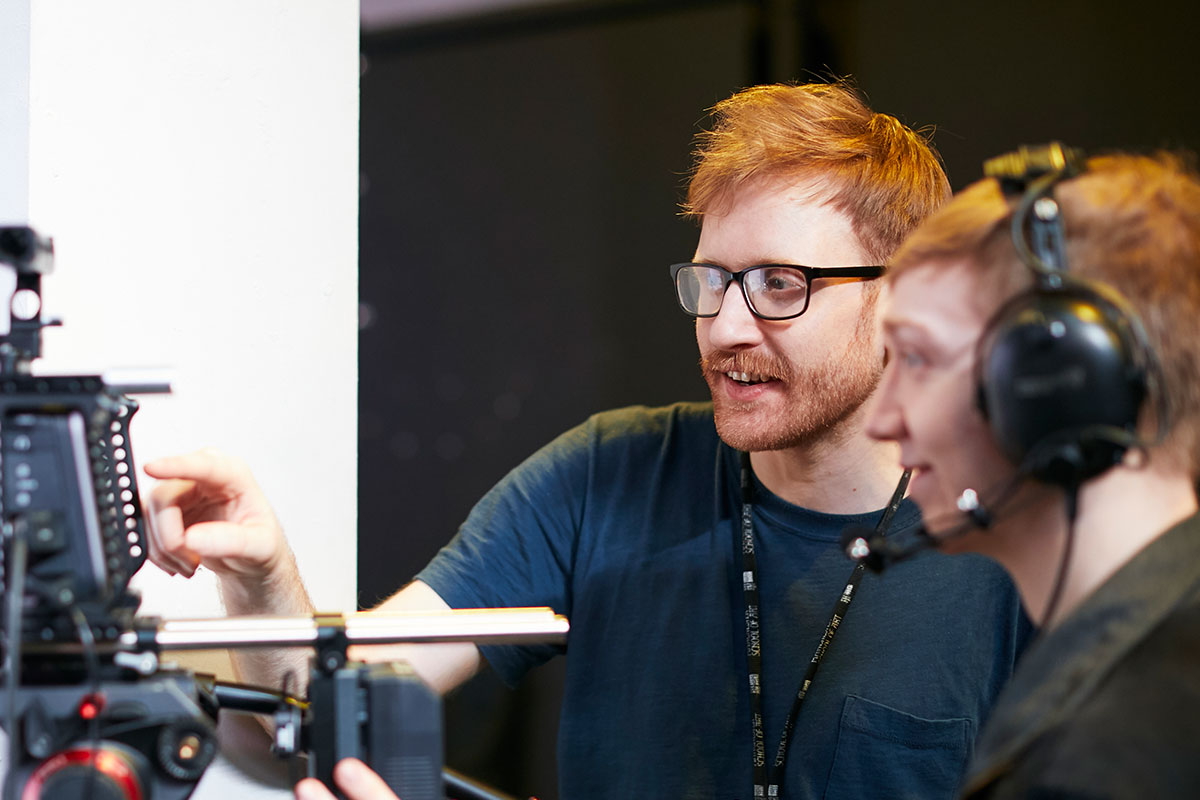
You'll have access to a full suite of industry standard facilities, including green screens, edit suites and film studios, as well as support from a team of specialist technical staff offer bespoke inductions and support.

Study in Manchester
This course positions filmmakers within one of the UK's key centres for screen industries, featuring everything from innovative start-ups to established companies like the BBC and ITV, all situated in nearby Salford’s Media City.

Innovative projects
Create projects that address challenging creative briefs across various formats, including narrative film, documentary, artists’ film, and immersive media, with opportunities for screening at esteemed national and international film festivals.
Accreditations, awards and endorsements

Year 1
Core modules
Film Practice as Research
Co-Creation for Sustainable Futures
Collaborative Film Production
Exploration of Film Craft
Independent Project
Study and assessment
Study
- Full-time 20% lectures, seminars or similar; 0% placement; 80% independent study
- Part-time 20% lectures, seminars or similar; 0% placement; 80% independent study
Assessment
- Full-time 100% coursework; 0% practical; 0% examination
- Part-time 100% coursework; 0% practical; 0% examination
Ten credits equates to 100 hours of study, which is a combination of lectures, seminars and practical sessions, and independent study. A masters qualification typically comprises of 180 credits, a PGDip 120 credits, a PGCert 60 credits and an MFA 300 credits. During the course, you are likely to be required to engage in collaborative projects, practical assessments, group work activities, and to give presentations to your peers/tutors. The exact composition of your study time and assessments for the course will vary according to your option choices and style of learning.

Taught by experts
MA Filmmaking is part of the School of Digital Arts (SODA) at Manchester Met. Discover more about the school and who you’ll be working with if you choose to study this course.
Entry requirements
Typical offer
Lower second-class UK honours degree (2:2)
Country-specific entry requirements
Find your country for specific entry requirements
Fees and funding
UK and Channel Island students
UK full-time fee £12,400 per year
UK part-time fee £2067 per 30 credits
EU and non-EU international students
International full-time fee £22,000 per year
International part-time fee £3667 per 30 credits
Fees may be subject to change. See the tuition fees section below for full details.
Tuition fees
Additional costs
Careers support and prospects
Employed or in further study
92.7% of our UK-domiciled, full-time, postgraduate taught graduates are employed or in further study 15 months after graduation.
Graduate Outcomes survey 2022/23 leavers, HESA data.
Explore your options and build sought-after skills

Earn while you learn
Find out more
Find your perfect placement
Find out more
Build skills for your future
Find out more
A career as unique as you
Your city, your community, your campus
Want to know more



How to apply
There are no online application routes, please contact our course enquiries team.
Get advice and support on making a successful application.
You can review our current terms and conditions before you make your application. If you are successful with your application, we will send you up to date information alongside your offer letter.
Related courses
Disclaimers
Programme review
Our programmes undergo an annual review and major review (normally at 6 year intervals) to ensure an up-to-date curriculum supported by the latest online learning technology. For further information on when we may make changes to our programmes, please see the changes section of our terms and conditions.
Important notice
This online prospectus provides an overview of our programmes of study and the University. We regularly update our online prospectus so that our published course information is accurate. Please check back to the online prospectus before making an application to us to access the most up to date information for your chosen course of study.
Confirmation of regulator
The Manchester Metropolitan University is regulated by the Office for Students (OfS). The OfS is the independent regulator of higher education in England. More information on the role of the OfS and its regulatory framework can be found at officeforstudents.org.uk.
All higher education providers registered with the OfS must have a student protection plan in place. The student protection plan sets out what students can expect to happen should a course, campus, or institution close. Access our student protection plan.